Running KAS Hashrate Alongside a BTC Farm
A KAS fleet and a Bitcoin farm cannot share machines, but they can share a building, a power feed and an accountant. At the readings of 22 Sept 2026 the two legs behave very differently: 20 PH/s of Kaspa hashrate returns about 110,730 KAS a day, near $4,742, while 300 TH/s of SHA-256 hardware returns 0.00014206 BTC a day, about $12.12 before the listed fee. The whole exercise is deciding whether that imbalance sits comfortably next to your power budget.

Key takeaways
- Kaspa and Bitcoin use different hashing functions, so no machine covers both legs — spares, firmware and support are separate line items.
- At current readings 20 PH/s of KAS produces roughly 110,730 KAS a day, near $4,742, against $11.63 a day net for 300 TH/s of Bitcoin hashrate.
- KAS revenue is about $237 per PH/s per day gross; Bitcoin works out near $38.77 per PH/s per day after the listed 4% on the block-reward leg.
- Revenue per PH/s is not a like-for-like comparison across the two legs, because the units are different machines with different power draw.
Two hashing functions, one building
SHA-256 and kHeavyHash have nothing in common at the silicon level. A machine bought for one network cannot be repointed at the other, which means a mixed site carries two unrelated inventories: two sets of spare parts, two firmware paths, two cooling profiles and two groups of suppliers. That is the first cost of mixing, and it is rarely written into the business case.
What the two fleets do share is the building. Breaker capacity, cable routing, airflow and generator headroom are all measured on the site rather than per coin, so a mixed operation usually gets better use of fixed costs than a single-coin operation of the same total size. You can fill a rack bay with whichever hardware is available rather than waiting for the right machine to appear.
Monitoring is where the split shows up daily. Kaspa moves in seconds and Bitcoin moves in minutes, so the numbers on two dashboards refresh at completely different rates. Reading them side by side is normal practice, but comparing a KAS hashrate dip with a Bitcoin hashrate dip on the same clock will mislead you about which one has a fault.
What each leg pays at current readings
The Kaspa side runs on a fixed emission: 2.18 KAS per block at about ten blocks a second, which is 1,885,832 KAS issued across the network every day and about $80,669 at a price of $0.042829. Divide 20 PH/s by the reported 340.2 PH/s of network hashrate and the share is 5.8789%, which is roughly 110,730 KAS a day, or $4,742.
The Bitcoin side is driven by difficulty instead of a block-rate constant. At a network difficulty of 132.76 T, which implies about 950.3 EH/s, the network issues 450 BTC a day — close to $38,382,300 at $85,294 per coin. One TH/s returns 0.0000004735 BTC a day gross, about $0.0404, and $0.0388 after the listed 4% on the block-reward leg. At 300 TH/s that is $12.12 gross and $11.63 net every day.
Two details matter when you put those numbers next to each other. The Bitcoin difficulty estimate for the next adjustment sits at +1.90%, and an independent three-day hashrate average of 942.8 EH/s is running a little below the difficulty-implied figure, which is a reminder that the daily issuance is stable while the hashrate chasing it is not.
| Measure | KAS leg (20 PH/s) | BTC leg (300 TH/s) |
|---|---|---|
| Daily output | About 110,730 KAS | 0.00014206 BTC |
| Daily value, gross | About $4,742 | $12.12 |
| Daily value, after the listed block-reward fee | $4,742 at the listed rate on the KAS legs | $11.63 |
| What sets the output | Fixed emission of 1,885,832 KAS a day shared by hashrate | 450 BTC a day shared by hashrate at 132.76 T |
| Share of network | 5.8789% of 340.2 PH/s | About 0.0000316% of 950.3 EH/s |
| Hardware overlap | None with the other leg | None with the other leg |
Worked example: six months of running both
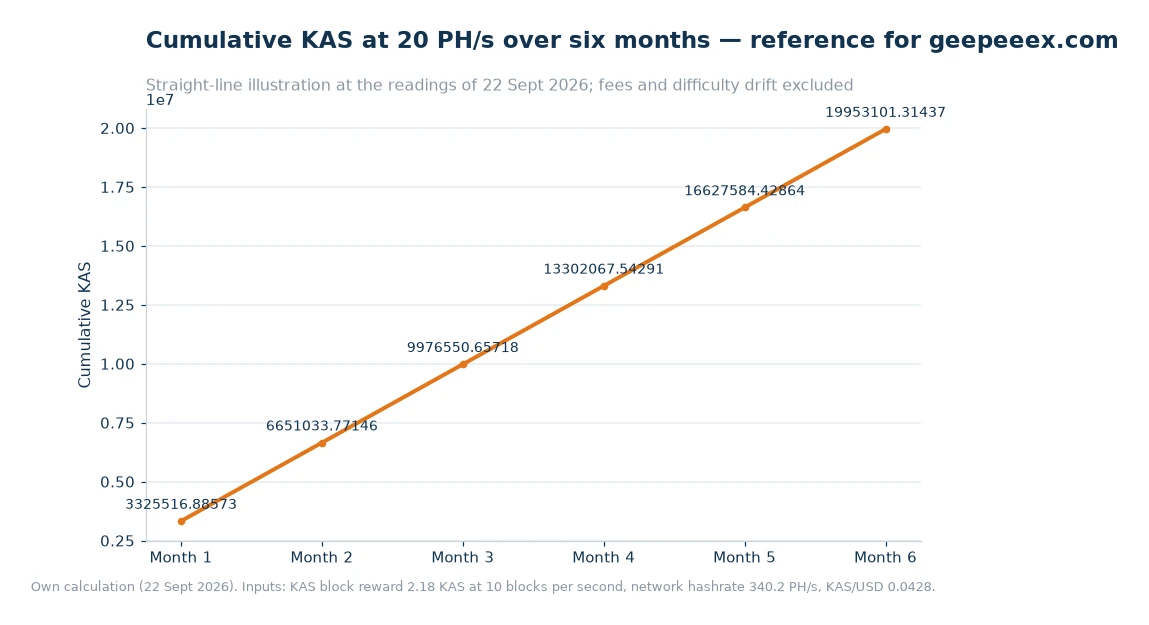
Take the Kaspa leg first. 110,730 KAS a day over 30 days is 3,321,905 KAS, and at $0.042829 that is $142,274 a month. Extend it to 180 days and the accumulation reaches close to 20 million KAS, roughly $853,600 — the curve shown below.
Now the Bitcoin leg on the same clock. 0.00014206 BTC a day is 0.004262 BTC a month, about $363.48, and 0.025569 BTC over six months at $85,294, which is $2,181. Add the two together and the site's six-month revenue is about $855,800, of which the Kaspa fleet accounts for the overwhelming share.
That last sentence is where mixed sites go wrong, so it is worth stating plainly: the KAS leg earns far more per PH/s than the Bitcoin leg, but a PH/s of kHeavyHash hardware is not the same purchase as a PH/s of SHA-256 hardware. The correct comparison is revenue per dollar of hardware and per kilowatt drawn, using the power figures from each vendor's own specification. Per-PH/s revenue across different hashing functions is a number that flatters whichever fleet happens to use cheaper machines.
Keeping two books straight
The Kaspa side is the one worth watching closely, because its output depends on a network hashrate that moves faster than most operators re-run their spreadsheets. The ViaBTC KAS Mining Pool view gives the live reading you need to recheck your share, and the same account holds the Bitcoin fleet's payouts, which is the practical reason to keep both legs together rather than splitting them across providers: one balance, one withdrawal schedule, one place to read six months of records.
Two other pages are worth a place in your bookmarks. The Mining Farms listing matters if part of either fleet sits in someone else's building, since hosting terms change the fixed-cost line you are trying to fill. And the listed mining pool fees are the only reliable way to subtract the right percentage from the right component on each leg instead of guessing at a blended rate.
Frequently asked questions
Can one machine mine both KAS and BTC?
No. The two networks use different hashing functions, so the hardware does not transfer between them. Budget for two separate inventories, two sets of spares and two firmware paths.
Which leg earns more per PH/s?
The Kaspa leg shows about $237 per PH/s per day gross against roughly $38.77 per PH/s per day net on the Bitcoin side. The units are different machines with different costs, so compare per dollar of hardware and per kilowatt instead.
Do the two fleets need separate accounts?
They do not. Both legs can settle into a single multi-currency account, which gives you one balance, one withdrawal schedule and one set of records to reconcile at month end.
Before you fill the next rack bay
Price both legs on the same day and with the same assumptions: output per unit of hardware, power draw, and the fee component each network actually charges. Keep the Kaspa share calculation in a spreadsheet cell rather than in your head, because a move in network hashrate changes it silently. Record which breaker feeds which fleet, so a single trip does not take out both legs at once. And when you add capacity, add it to the leg where the next dollar of hardware buys the most delivered hashrate per kilowatt, not to the leg with the better headline revenue per PH/s.
Data and sources: Kaspa readings — 2.18 KAS per block at about ten blocks a second, 1,885,832 KAS issued daily, network hashrate 340.2 PH/s, KAS at $0.042829 — and Bitcoin readings — difficulty 132.76 T, next adjustment estimated +1.90%, implied network hashrate 950.3 EH/s against a three-day average of 942.8 EH/s, 450 BTC issued daily, BTC at $85,294 — plus the ViaBTC listed fee schedule[1], all read 22 Sept 2026. Figures are arithmetic on those inputs and change with difficulty, hashrate and price.